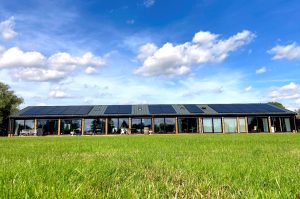
We are proud to reflect on the inclusion of Pilgrims’ Barn in the scientific paper presented by Nick Woolley and Stuart McHendry at the International Sustainable Energy Conference 2026 in Graz. Their report showcased Pilgrims’ Barn as an exceptional example of how traditional rural architecture can be successfully transformed through advanced sustainable design to create a blueprint for the future of low-carbon living.
Originally an old farm building, Pilgrims’ Barn was meticulously reimagined through a self-build project that demonstrates what is possible when heritage buildings are paired with modern environmental thinking. The renovation enabled the property to exceed Passivhaus standards while achieving an outstanding EPC rating of A134. Even more remarkably, it was delivered at a lower cost per square metre, including developer’s profit, than many conventional construction projects; in addition, it demonstrated outstanding Whole Life Carbon Assessment results. These both prove that high-performance, sustainable buildings can be both practical and cost-effective.
Energy Independence in Practice
At the heart of Pilgrims’ Barn’s success is an integrated renewable energy system designed for resilience and independence. A substantial solar array built into the roof generates enough clean electricity to meet the site’s annual energy demand. This is supported by significant battery storage capacity, allowing the building to operate entirely off-grid electrically — including electric vehicle charging for two cars.
The system’s performance extends beyond self-sufficiency. During the past year, Pilgrims’ Barn exported more than 5 megawatts of surplus energy back to the National Grid. This positions the property as a compelling example of decentralised energy design, reducing dependence on traditional utilities while contributing positively to wider energy networks.
Sustainable Water Management
Sustainability at Pilgrims’ Barn extends beyond energy generation. Water stewardship is central to the project’s ethos, with a comprehensive reclamation system that captures and reuses all rainwater from the roof. This supports daily operations while also supplying one of the property’s most innovative features — a rainwater-fed swimming pool and wildlife pond.
This closed-loop approach demonstrates how thoughtful design can dramatically reduce resource consumption while maintaining comfort, functionality and a high standard of living.
A Real-World Case Study, incorporating the Four Columns of Sustainable Construction.
At the Graz Conference 2026, Pilgrims’ Barn provided delegates with a tangible case study for discussions around:
- Whole Life Cycle Carbon Integrity
- Ultra-Low Energy Demand with Energy Autonomy
- Fully Integrated Water Management
- Healthy Indoor Environments
Its unique blend of heritage preservation, engineering innovation and ecological ambition made it a fitting subject for the conference and an inspiring model for businesses, designers and policymakers exploring the future of sustainable development.
Continuing the Conversation
The inclusion of Pilgrims’ Barn in this important scientific paper reinforces a vital message: existing buildings can play a major role in the transition to a low-carbon future. With imagination, technical expertise and commitment, traditional rural structures can be transformed into world-class examples of environmental performance.
Pilgrims’ Barn is a powerful demonstration of what is possible when sustainability and expert design work hand in hand.
See the paper here: https://www.woolley.co.uk/wp-content/uploads/2026/04/09032026-ISEC-26-GRAZ-Conference-Paper-NW-SM-Pilgrims-Barn-2-3.pdf
PIlgrims Barn Energy Use Jan to Dec 2025